Science (SCI)
The Science (SCI) domain focuses on observation, exploration of people and objects, and investigation of objects and concepts. The knowledge or skill areas in this domain include cause and effect, inquiry through observation and investigation, and documentation and communication of inquiry.
 Meet Nova Quest,
Ambassador for Science!
When Nova Quest woke up that morning, she was a little nervous. She was the last scheduled Ambassador to speak at the school, and she wondered if her classmates would be too tired to listen to all the important information she needed to share. For instance, how doing one thing leads to another thing, and how asking a lot of questions and figuring out how things work helps kids learn, and how important it is to share what you learn with others!
Science is a lot of tiny things happening all at once, working together and apart, then coming together to form something new; like when one ant tells another ant and soon there is an army of ants to move one itsy-bitsy potato chip into the ant house cafeteria. Or, when astronauts go to the moon and bring back a piece to earth to study because maybe one day, we’ll have giant playgrounds on the moon!
Science is important and science is fun – and that gave Nova a great idea to keep the kids interested in her speech. She would get to school early and ask the teachers for help!
This was going to be EPIC!
Backstage, Nova was excited. Her fellow ambassadors had made all their speeches and now it was her turn. She had been cheering everyone on; Emery, who spoke on Approaches to Learning, and Luna, on Social and Emotional Development, and Santiago, on Language and Literacy Development, and Tano, on Health, and Kai, on Physical Development, and Elliot on Math. What a fun day of learning and laughing! And now… it was Nova’s turn to share.
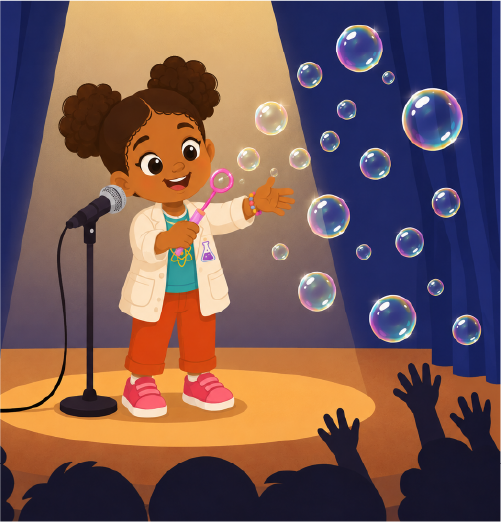
Nova walked to the microphone and noticed some of the kids were squirming and she was glad she’d planned to keep things going to the end.
“Hi! I am Nova Quest, Ambassador for Science! Who wants to do an experiment?”
The kids cheered.
“Look under your seats!”
The kids looked under their seats and squealed in delight.
“Let’s blow some bubbles!”
Nova blew a string of tiny bubbles, which reflected the stage lights and floated above the audience like magical little orbs.
The crowd went wild!
While everyone was blowing bubbles and laughing, Nova explained, “Weee! I love bubbles! Bubbles are made of soap, water, and air. Before you blew into the bubble wand, it was just like dish soap. But when you blow air into the wand, the air gets trapped with a little bit of water and makes a bubble, which floats around until the water evaporates. Then the bubble POPS, and the air escapes!"
“And that’s science! Isn’t it fun? That’s the end of our Learning Domain assembly. And now…one last message from your ambassadors!”
Emery, Luna, Santiago, Tano, Kai, Elliot and Nova all joined hands on stage, took a bow among the floating, iridescent bubbles, and yelled, “RECESS IS HERE!”
The End.
(Check back after summer break to find out what the ambassadors learned over their summer! Have a great summer!)
Science Progression
|
Infant-Toddler |
Preschool |
School-Age |
|
|
Cause & Effect |
Nova pushes a button on a bubble machine and watches bubbles float into the air. She repeatedly presses the button again each time the bubbles stop. |
Nova jumps in a puddle and notices mud splashing onto her shoes and pants. She stomps again and watches the water splash even higher. |
Nova places one ice cube in the sun and another in the shade. After observing that the ice cube in the sun melts faster, Nova records her findings that the sun’s heat makes the ice melt faster. |
|
Inquiry & Investigation |
While Nova is playing at the water table she notices that some objects sink while others float. She drops different toys into the water, watches what happens, and reaches for new objects to try again. |
Nova notices a line of ants carrying crumbs across the playground. She crouches down to watch them closely, following where they are going. Then, Nova places a small leaf near the ants to see what they will do. |
Nova tests different paper airplane designs to see which flies the farthest. She records that the airplanes with wider wings stay in the air longer. |
|
Documentation |
During sensory play, Nova repeatedly fills and dumps water from a small cup into a larger container. |
Nova notices that several snails are gathered near the garden after it rained. She collects leaves and small rocks to create a habitat for the snails in a sensory bin. |
During a STEM activity, Nova records the daily temperature and weather conditions for two weeks. After reviewing the data with her group, Nova notices that warmer days were sunny and cooler days were cloudy or rainy. |